


Paver Installation FAQs
Common questions about paver installation, materials, and maintenance.
Common Questions
Straight answers from a licensed California general contractor. If you have a question that is not covered here, contact Buildda for a no-obligation consultation and a specific, transparent answer for your project in Los Angeles.
How long do pavers last?
Quality pavers last 25-50 years or more with proper installation. Concrete pavers typically run 25-30 years; natural stone like flagstone or travertine can run 50-plus years. The deciding factor is the base, not the paver itself, since most failures show up underneath rather than on the surface. Drainage at the base prevents the saturation issues that shorten lifespan.
What's the difference between concrete pavers and natural stone?
Concrete pavers are manufactured for uniform size and color, which makes installation faster and the price lower (typically $12-25 per sq ft installed). Natural stone like flagstone or travertine has unique color variation and a more premium look, costs more ($25-40 per sq ft), and requires more skilled labor to fit irregular pieces cleanly. Both share the same base requirements underneath.
How long does paver installation take?
Most residential paver projects take 3-7 days on-site. A typical driveway (400-600 square feet) runs 3-4 days; a larger patio with complex patterns or curves can take 5-7 days. The timeline includes excavation, base prep with multiple compaction lifts, paver placement, edge restraints, and joint-sand activation. Weather and unexpected base conditions can shift the schedule.
Do pavers require a permit in Culver City?
Patio and walkway pavers usually do not require a permit in Culver City. Driveway work that changes drainage patterns, expands the impervious surface area, or connects to the public sidewalk often does need approval. We research the permit requirement on every project before quoting and file the application if one is required by the local building department.
Can pavers be installed over existing concrete?
Yes, if the existing concrete is in good structural condition and properly sloped for drainage. We use a thin sand setting bed over the concrete for the bond. If the concrete is cracked, heaving, or sloping the wrong direction, removal is the better option, since installing on top of failing concrete just hides the underlying problem temporarily and shortens the new surface's life.
How do I maintain my pavers?
Pavers are low maintenance. Sweep regularly to prevent surface debris from working into the joints, rinse with a garden hose occasionally, and pull any weeds that appear. Re-apply polymeric sand every 3-5 years as foot traffic and weather wear it down. Sealing is optional but slows staining and enhances color depth, especially on natural stone surfaces.
Will pavers shift or settle over time?
With proper installation (4-6 inches of compacted base, edge restraints, and full polymeric-sand joints), pavers rarely shift on residential surfaces. If individual pavers do settle, the design advantage is repairability: lift the affected pavers, top up the base material, and reset them. Poured concrete cannot be repaired this way; the whole slab fails when the base does.
What is polymeric sand and why is it important?
Polymeric sand contains polymers that harden when activated with water, locking pavers together at the joints. It prevents weed growth, ant hills, and joint erosion under foot traffic. It is essential for a long-lasting installation. Without it, the joints fill with dirt, weeds take over within a year, and individual pavers start to rock under weight as the joint material washes out.
Are pavers slippery when wet?
Most pavers have a textured surface that provides good traction when wet. For pool decks or sloped walkways, we use pavers specifically rated for slip resistance with a more pronounced texture. Sealing slightly reduces traction, so on wet-prone areas we either skip the sealer or use anti-slip-rated formulations. The texture choice should be made at the consultation.
Can damaged pavers be replaced?
Yes, and this is one of the design advantages of pavers over poured concrete. Individual damaged pavers can be lifted out and replaced without disturbing the surrounding surface. We recommend keeping a few extra pavers from the original installation for future repairs, since color matches across batches can shift over the years as manufacturers retool molds and pigments.
What paver patterns do you offer?
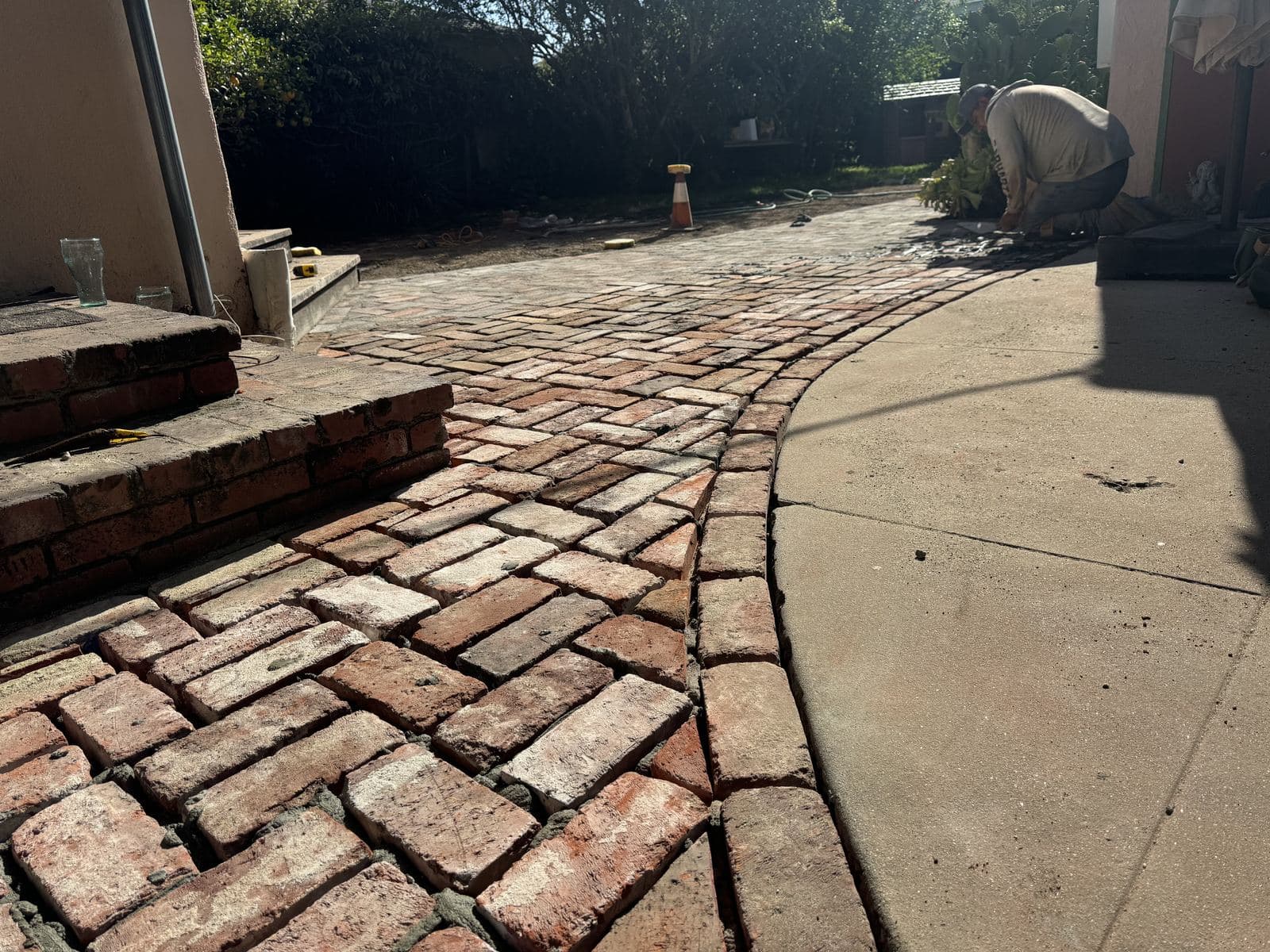
We install all common patterns: running bond, herringbone (at 45 or 90 degrees), basket weave, and circular designs. Herringbone is the strongest pattern for driveways because it locks the most paver edges together and resists turning forces from car tires. Running bond and basket weave are more popular for patios where the load is foot traffic only.
How do pavers compare to stamped concrete?
Pavers cost slightly more upfront than stamped concrete but offer easier repairs, no cracking issues, and a longer lifespan. Stamped concrete is poured as one continuous slab, so when it cracks (and concrete always cracks eventually), the damage shows across a large area visibly. Pavers flex at the joints with ground movement and can be individually replaced when needed.
Get Paver Installation s in Your Area
Professional services available throughout Los Angeles
Or get a personalized quote:
Have More Questions?
Contact us for a personalized consultation about your project.
Content reviewed by Shiran Levy, Licensed General Contractor (CA #1131088)
Last updated: October 2026